01
The Human Before the Role
Before profession, productivity, status and social identity stands a developing human being whose life cannot be reduced to function.
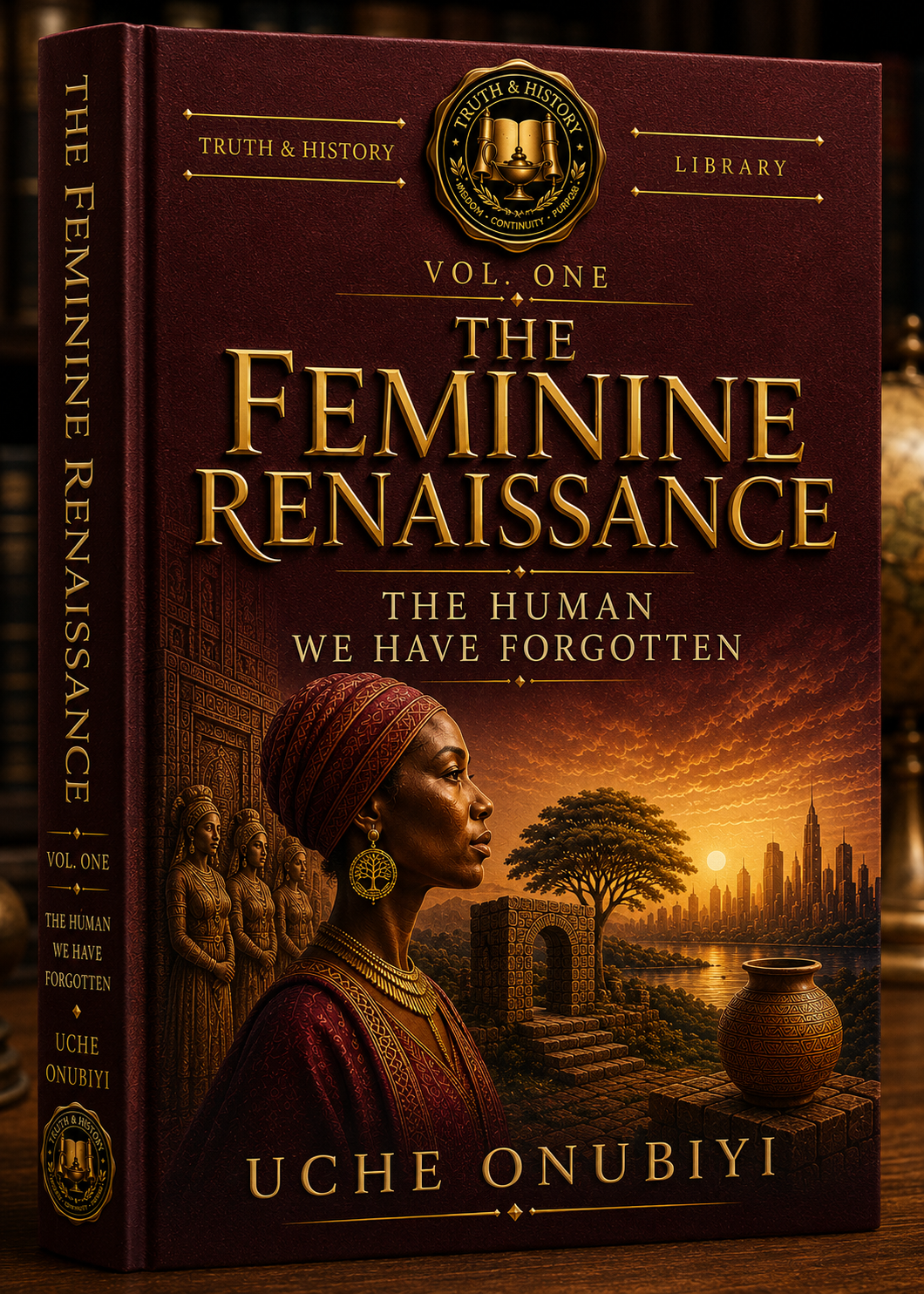
The Feminine Renaissance · Volume One
Before restoration can begin, something must be remembered.
An inquiry into the human capacities modern civilization has neglected—and the feminine principle as part of the recovery of a more whole understanding of human life.
Uche Onubiyi
Share This
About Volume One
We have become extraordinarily skilled at describing what human beings do. We classify people by profession, productivity, nationality, status, achievement, consumption and social role. Yet beneath all these descriptions remains a more fundamental question: what is a human being becoming?
The Human We Have Forgotten begins the Feminine Renaissance by returning to this question. It examines the human being as developing, relational, embodied, meaning-making life rather than merely as a productive resource.
From there, the inquiry turns toward the feminine—not simply as woman or female, but as a cluster of life-serving capacities expressed through reception, nurture, protection, relationship, carrying, regeneration and maturation.
The Renaissance begins with memory because we cannot restore what we no longer recognize.
The Beginning
Before we can restore balance,
we must understand what was lost.
The Forgotten Human
01
Before profession, productivity, status and social identity stands a developing human being whose life cannot be reduced to function.
02
Human formation takes place through relationship. We receive, respond, learn, carry, nurture and become within networks of life.
03
Knowledge alone does not complete a person. What we repeatedly receive, interpret and practise participates in what we become.
04
Thought, emotion, embodiment, relationship, responsibility, meaning and action belong to one developing life.
The Feminine
The inquiry distinguishes biological sex from the broader human capacities associated with receiving, nurturing, protecting, relating, carrying, regenerating and bringing life toward maturity.
The recovery of the feminine is therefore not a project for women alone. It is part of the recovery of the human.
Seven Capacities
To encounter before immediately controlling.
To create conditions in which life can develop.
To guard what is vulnerable while it matures.
To recognize that life develops through connection.
To remain with a process long enough for formation.
To make renewed life possible after disruption.
To bring potential toward responsible fruit.
Knowledge and Formation
A civilization can accumulate extraordinary information without necessarily producing wiser human beings. Knowledge expands what we know; formation concerns what repeated knowledge, experience, relationship and practice are making of us.
This distinction becomes increasingly important in an age where information is abundant. Access to knowledge does not guarantee understanding, and understanding does not automatically become wisdom.
The question of formation therefore returns throughout the Renaissance: what kind of human is this way of living producing?
Africa Remembers
African memory offers ways of thinking about personhood that place human life within community, ancestry, land, responsibility, motherhood, elderhood, rhythm and reciprocity.
These memories should not be romanticized as evidence of a perfect past. Their importance lies in the questions they allow the present to ask about forms of human relationship that highly individualised modern systems can overlook.
Remembering therefore does not mean reproducing an ancient society. It means recovering useful human wisdom without surrendering critical examination.
What Was Silenced?
When conquest, competition, extraction, speed, control and measurable productivity dominate a civilization's definition of progress, other capacities can become less visible. Care, gestation, relationship, nurture, patience, regeneration and interdependence may continue to sustain life while receiving less public value.
Care
Relationship
Nurture
Regeneration
Questions Inside Volume One
What does it mean to be human beyond productivity and status?
What happens when knowledge increases but formation weakens?
Why do technologically connected societies experience profound isolation?
What human capacities have modern systems undervalued?
What has the suppression of the feminine cost both women and men?
What can African memory contribute to the recovery of human wholeness?
What must be remembered before a genuine renaissance can begin?
The Whole Human
It asks whether capability can be reunited with relationship, knowledge with wisdom, power with nurture, individuality with responsibility, and progress with the conditions that allow life to flourish.
Remember
Volume One therefore does not end with a completed answer. It ends at a threshold. Once the forgotten dimensions of the human become visible again, another question emerges:
What must now be restored?
About the Author
Uche Onubiyi is an author and researcher whose work explores human formation, history, scripture, memory and the recovery of life-serving patterns of knowledge. Through The Feminine Renaissance, she examines what humanity may need to remember, restore and manifest in response to the challenges of the modern world.
About the Coordinator →The Feminine Renaissance Collection
Volume One · Current
Volume Two
Open Volume →
Volume Three
Open Volume →