
We began this collection with a simple proposition:
the woman is a living calendar.
Not because every woman follows one identical cycle.
Not because the female body can be reduced to menstruation, fertility or reproduction.
And not because biology should dictate the boundaries of a woman's life.
The proposition was larger.
Human beings are living organisms, and living organisms do not inhabit time as clocks do.
We sleep and wake.
We activate and recover.
We prepare, produce, release and renew.
We enter developmental stages. We cross thresholds. We remember. We age. We inherit time from those before us and leave memory for those who come after us.
The female body makes some of these transitions unusually visible.
But visibility alone is not wisdom.
The question at the end of this collection is what we do with what we have learned to notice.
What changes when you stop merely living inside time
and begin recognizing the time you are living through?
01 · You Are Not a Machine With a Schedule
Rhythm is not the enemy of discipline.
Recovering rhythm does not mean abandoning calendars, appointments, deadlines or responsibility.
Human communities need shared time.
The clock allows people who inhabit different bodies, circumstances and rhythms to coordinate their actions.
That is an extraordinary achievement.
The problem begins when coordination becomes our entire philosophy of time.
A clock can tell two people to arrive at nine o'clock.
It cannot tell either person whether she is rested, recovering, grieving, beginning, completing, fertile, menopausal, ill, flourishing or exhausted.
Those belong to another layer of time.
Becoming a keeper of rhythm means learning to inhabit both: shared time and living time.
Diagram 01 · The Keeper's Path
Recognition becomes participation.
02 · Observe Before You Interpret
Attention is the beginning of temporal literacy.
Throughout this collection, one discipline has returned again and again:
observe before concluding.
Notice when you sleep.
Notice when you recover.
Notice what returns.
Notice what has stopped returning.
Notice what changes during particular periods of stress, activity, menstruation, recovery or transition.
But do not rush from observation to explanation.
A recurring experience is evidence that something recurs.
It is not automatically evidence for whatever theory we prefer about why it recurs.
This distinction protects curiosity.
We do not need to deny experience in order to remain rigorous, and we do not need to exaggerate experience in order to honor it.
The first responsibility of the timekeeper
is not explanation. It is attention.
03 · Memory Turns Events Into Patterns
What is not remembered is difficult to recognize when it returns.
A living calendar requires memory.
This memory can be biological, personal, familial or cultural.
At the personal level, it may be as simple as recording dates, symptoms, energy, sleep, work intensity or moments of transition.
At the family level, it may mean listening to the women who remember births, migrations, illnesses, marriages, ruptures, recoveries and changes that happened before we arrived.
At the cultural level, it may mean examining practices and stories through which communities tried to make sense of recurring time.
None of these archives is infallible.
Personal memory can distort.
Family memory can omit.
Cultural tradition can preserve insight and error together.
But without memory, recurrence continually appears new.
Memory gives the present something with which to compare itself.
Diagram 02 · Three Archives of Time
Body
Embodied Archive
Sleep, recovery, menstrual history where applicable, symptoms, developmental change and other recurring bodily experiences.
Life
Personal Archive
Work, relationships, creativity, grief, recovery, seasons of intensity, periods of withdrawal and moments of transition.
Generations
Inherited Archive
Family memory, oral testimony, cultural practices and the experiences transmitted by those who lived before us.
04 · Discernment Is More Than Pattern Recognition
A pattern can be real without our explanation of it being correct.
Suppose a woman notices that a particular experience tends to recur at a similar point in her menstrual cycle.
The observation matters.
But several questions remain.
Does it happen consistently?
What else changes at the same time?
Is the relationship biological, environmental, behavioral or coincidental?
Has the pattern changed over the years?
Does research support the proposed explanation?
Is professional assessment appropriate?
Discernment refuses two extremes.
It does not dismiss experience because every mechanism is not yet known.
And it does not transform every repeated experience into a universal law.
The keeper of rhythm learns to remain curious without becoming careless.
05 · Alignment Is Not Submission to Every Feeling
Living with rhythm still requires choice.
Alignment can easily be misunderstood.
If we say, “Listen to your body,” we may accidentally imply that every sensation should determine action.
That is not what this collection proposes.
Sometimes we are tired and must still fulfill an important responsibility.
Sometimes discomfort accompanies growth.
Sometimes rest is necessary.
Sometimes the appropriate response to a bodily signal is medical care rather than lifestyle interpretation.
Sometimes the body is changing permanently and the wiser response is adaptation.
Alignment therefore requires judgment.
It means allowing reality to inform our choices instead of demanding that reality continually conform to our plans.
Diagram 03 · Alignment Is a Conversation
Inner Conditions
Body
Energy
Health
Emotion
Developmental stage
Need for recovery
Outer Conditions
Responsibility
Relationships
Work
Environment
Resources
Shared schedules
Wisdom asks how the two can be brought into the most responsible relationship possible.
06 · Participation Replaces the Fantasy of Control
You can influence your life without controlling every season.
Human beings possess agency.
We plan, choose, build, prepare, protect, intervene and create.
Yet agency is not sovereignty over every condition.
We cannot command the body never to age.
We cannot decide that recovery should always happen according to our preferred deadline.
We cannot force every season to produce fruit.
We cannot preserve every relationship, prevent every loss or guarantee every outcome.
Participation is a more mature posture.
It asks:
What is within my responsibility?
What condition am I actually in?
What is changing beyond my control?
What can I prepare for?
What must I accept?
What can I still shape?
The keeper does not dominate time. She learns how to act responsibly within it.
07 · Your Rhythm Is Not a Template for Every Woman
Self-knowledge should make us less eager to universalize.
One of the dangers of discovering a personal pattern is the temptation to turn it into a rule for everyone else.
Women differ.
Bodies differ.
Menstrual cycles differ.
Experiences of pregnancy, infertility, menopause, illness, disability, ageing and recovery differ.
Social conditions differ.
Even one woman's rhythms can change across her lifetime.
The purpose of bodily literacy is therefore not to discover the schedule every woman should obey.
It is to become more attentive to the particular life you have actually been given to inhabit.
08 · The Keeper Eventually Becomes a Memory
What you learn about time does not have to end with you.
Journal 10 considered the elder woman as keeper of time.
But no woman begins as an elder.
The archive is built gradually.
What you observe now may become the memory through which you understand a later season.
What you learn through a difficult transition may become the language that helps another woman name hers.
What you discover was mistaken in your inheritance may help prevent an error from becoming tradition.
What you recover may survive because you transmitted it.
Timekeeping therefore becomes intergenerational.
We receive time. We inhabit time. We interpret time. And eventually, we become part of someone else's memory of time.
The Woman as Timekeeper · The Complete Journey
Twelve Journals. One recovered relationship with time.
The Woman Is a Living Calendar
The body carries recurrence.
Separated from Natural Time
Clock time is not the only time humans inhabit.
The Feminine Does Not Move in a Straight Line
Living processes include return, recurrence and renewal.
The Womb Knows Something the Clock Does Not
Formation requires protected developmental time.
Menstruation: The Body That Remembers Rhythm
Recurrence makes embodied time visible.
The Forgotten Intelligence of Rest
Restoration is part of living rhythm, not its interruption.
Why Every Season Cannot Be a Season of Production
Fruit is only one phase of a living process.
Woman, Moon and Memory: What Can We Actually Say?
Observation must remain distinct from proof and interpretation.
From Biological Clock to Living Calendar
One body participates in multiple interacting rhythms.
The Elder Woman as Keeper of Time
Lived time can become intergenerational memory.
When the Body Says It Is Time
Changing patterns can signal that a threshold deserves attention.
Becoming a Keeper of Your Own Rhythm
Recognition becomes conscious participation.
Keeper of Rhythm Practice
Build your living calendar.
You do not need to track everything. Choose a few dimensions that are genuinely relevant to your life and observe them over enough time for patterns to become visible.
Observe
Record what happened without immediately explaining why.
Compare
Look across weeks or months rather than treating one day as a pattern.
Contextualize
Notice sleep, stress, work, environment, menstrual timing where applicable, illness, travel and major life events.
Question
Ask what the evidence actually supports and what remains interpretation.
Respond
Where a pattern is meaningful, decide what responsible adaptation, investigation or action is appropriate.
Review
Return periodically. A rhythm that described you last year may not describe you now.
A personal rhythm record can support self-awareness, but it is not a substitute for medical evaluation when symptoms are new, severe, persistent or concerning.
Formation Insight
The Woman as Timekeeper is not the woman who controls time.
She is the woman who has learned to recognize it.
She knows that recurrence is not sameness.
She knows that rest is not absence.
She knows that fruit is not the whole cycle.
She knows that a signal is not yet an explanation.
She knows that a threshold can require adaptation.
She knows that memory must be examined before it becomes wisdom.
And she knows that recognizing a season does not remove her responsibility for how she lives within it.
Evidence · Experience · Tradition · Interpretation
Evidence
Circadian timing, sleep-wake regulation, reproductive cycling, developmental transitions and other biological rhythms provide the physiological foundation for discussing embodied time.
Experience
Personal observation can reveal recurring experiences and meaningful changes within an individual life. Observation deserves attention without automatically becoming universal evidence.
Tradition
Communities have developed many ways of interpreting bodily, seasonal and celestial cycles. These traditions can preserve valuable historical memory while still requiring contextual study and critical examination.
Formation Interpretation
“The Woman as Timekeeper” and “living calendar” are the interpretive frameworks of this collection. They describe a relationship to recurrence, memory, season, threshold and participation; they are not claims that women possess a separate anatomical organ for measuring time.
Carry This With You
What time are you living through?
What has been returning in your life?
What has changed enough that an old pattern no longer describes you?
What are you producing?
What are you still forming?
What needs rest?
What needs release?
What needs investigation rather than interpretation?
What season are you resisting because you preferred the one before it?
What wisdom are you already carrying that another generation should not have to rediscover alone?
The Woman as Timekeeper · Closing
The body remembers.
The seasons change.
The elder carries memory.
The threshold announces transition.
And the conscious woman learns to recognize where she stands.
She does not need to escape the clock.
She needs to remember that the clock was never the whole of time.
Observe.
Remember.
Discern.
Align.
Participate.
Transmit.
Become a keeper of your own rhythm.
Collection Complete
The Woman as Timekeeper
You have reached the end of this twelve-Journal exploration of body, rhythm, cycles, memory and becoming.
Return to the Collection →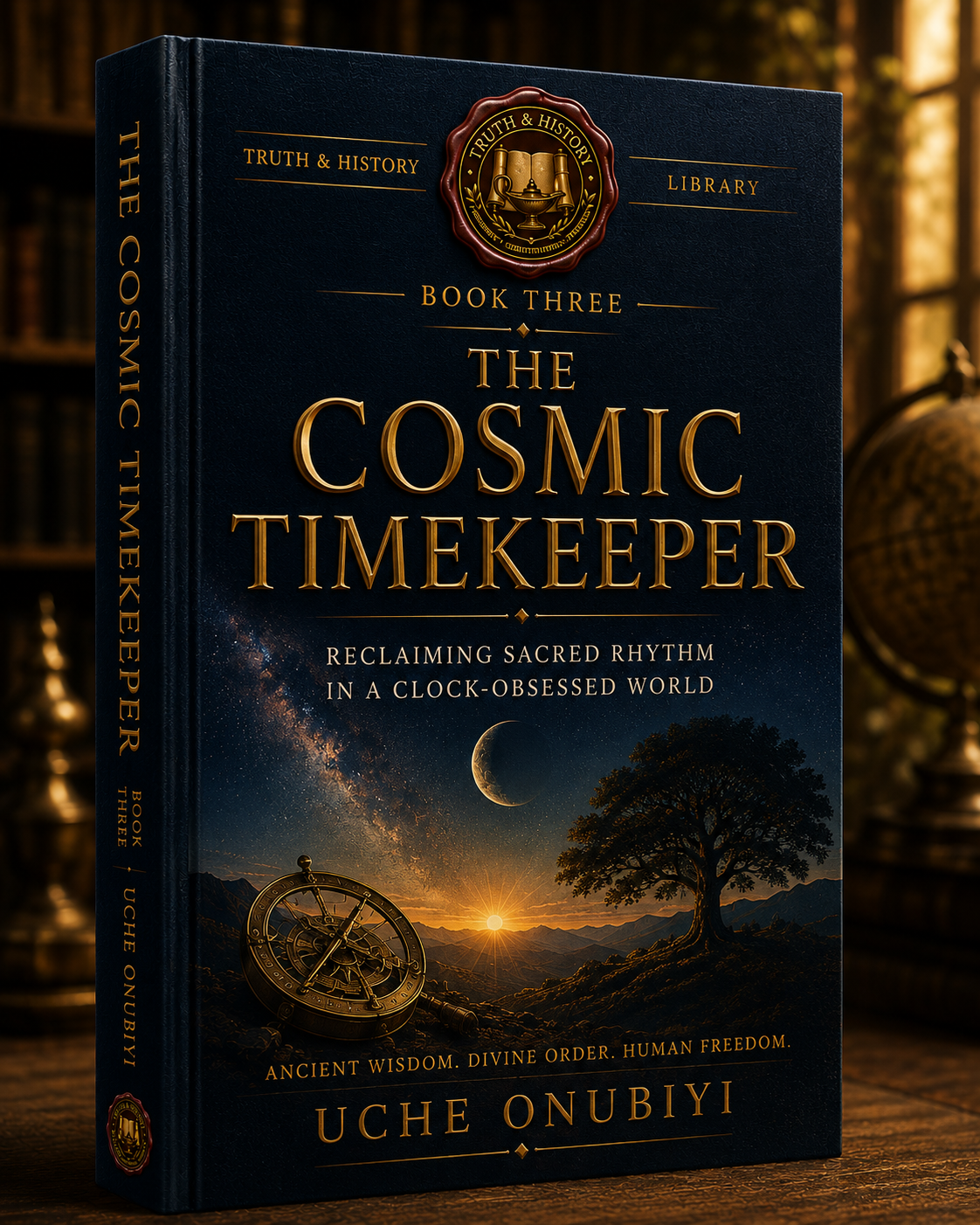
Continue the Exploration
The Cosmic Timekeeper
Go deeper into natural time, biological rhythm, cyclical movement, seasonal intelligence and the relationship between measurable time and the living processes through which human life unfolds.
Read the Book →