
Measured Time
Clock
Minutes, hours, schedules, deadlines and standardized units allow human activity to be coordinated with remarkable precision.
How much time has passed?
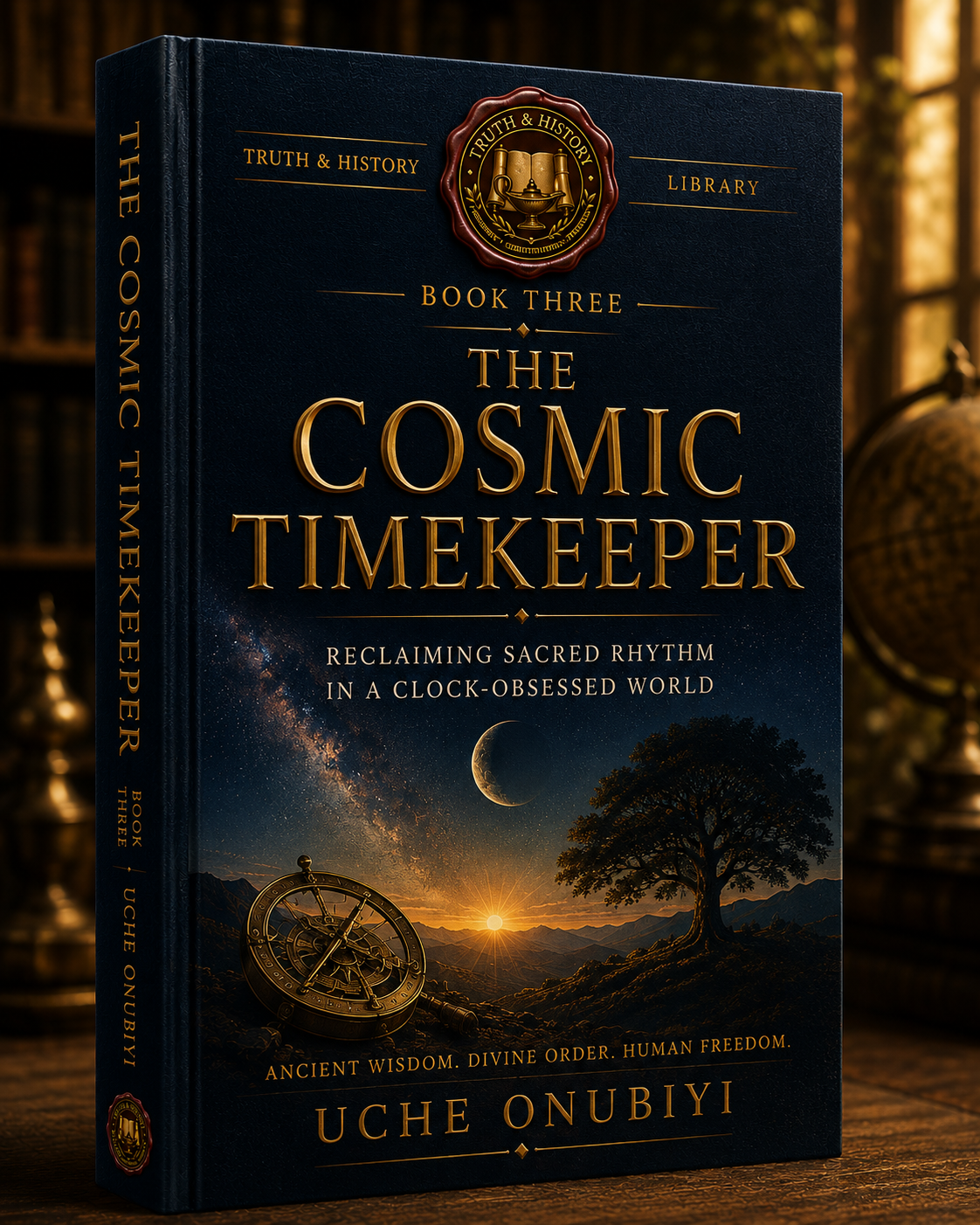
Truth & History Library · Book Three
Reclaiming Sacred Rhythm in a Clock-Obsessed World
An inquiry into the difference between measuring time and living within rhythm—and what humanity may have forgotten when the clock became master of the day.
Uche Onubiyi
Share This
About the Book
Human beings did not invent time when they invented clocks. Long before mechanical hours divided the day, communities observed light and darkness, lunar movement, seasons, planting, harvest, rest and recurring celestial patterns.
The Cosmic Timekeeper explores what happens when time is understood not merely as quantity, but as rhythm. It asks whether the modern ability to measure time with extraordinary precision has necessarily taught us how to live within it.
The inquiry moves through natural cycles, sacred calendars, appointed times, work, rest, memory and formation to recover a deeper question: not simply, “What time is it?” but “What kind of time are we in?”
The Central Question
We learned to measure time.
Did we forget how to read it?
Two Ways of Encountering Time
Measured Time
Minutes, hours, schedules, deadlines and standardized units allow human activity to be coordinated with remarkable precision.
How much time has passed?
Rhythmic Time
Light, darkness, moon, season, growth, rest and recurrence locate human activity inside patterns larger than individual schedules.
What is this time for?
The book does not require the rejection of clocks. It asks what is lost when measurement becomes our only language for understanding time.
The Cosmic Rhythms
01
Light and darkness establish a recurring rhythm before the mechanical clock enters the human story.
02
The changing moon makes time visible through phases, recurrence and observable movement.
03
The year carries rhythms of emergence, growth, harvest, decline, rest and renewal.
04
Appointed times interrupt undifferentiated activity and reconnect human life with memory, meaning and formation.
Reading the Pattern
Recurrence allows memory to be carried through time. A cycle returns, but the human being encountering it has changed.
Sacred Time
A sacred calendar does more than count days. It places memory inside recurrence. The return of an appointed time invites a community to remember, rehearse, reflect and participate again.
The cycle therefore does not need to mean mechanical repetition. Return can carry memory forward. The same appointed time is met by people who have lived another year, experienced new consequences and entered another stage of formation.
Time becomes a teacher when recurrence is joined to memory.
Work · Rest · Formation
A culture governed entirely by productivity can interpret rest as interruption, delay or lost economic opportunity.
Rhythmic time offers another possibility. Activity and cessation can belong to the same process. Growth itself contains periods that appear inactive while essential work continues beneath the surface.
Rest can therefore become boundary, remembrance, recalibration and resistance to the idea that human worth is identical to constant output.
Questions Inside the Book
What happened when humans moved from observing time to controlling it?
What is lost when every hour is treated as economically interchangeable?
Why did ancient communities read the heavens as signs of rhythm and season?
What is the difference between measuring time and understanding it?
How do sacred rhythms preserve collective memory?
Can rest be understood as part of formation rather than the absence of productivity?
What would it mean to live with time rather than merely race against it?
A Clock-Obsessed World
The modern problem is not that clocks exist. It is that measured time can become the unquestioned authority by which work, rest, worth, attention and even human development are judged.
A civilization can know the exact hour and still misunderstand the season.
Reclaiming Rhythm
Notice light, darkness, season, body and environment again.
Recover the memories and meanings carried by recurring times.
Let work, rest and attention occupy their proper places.
Live within rhythm rather than treating time only as a resource to consume.
Final Reflection
It is how to inhabit it consciously—to recognize rhythm, discern season, preserve memory, honour limits and understand that not everything meaningful develops at the speed of the clock.
About the Author
Uche Onubiyi is an author and researcher whose work explores history, scripture, formation, human purpose and the recovery of neglected patterns of knowledge. Her writing asks how inherited systems of thought shape the way human beings understand themselves, their origins and the world they inhabit.
About the Coordinator →Next Book
Global Threats, Emerging Technologies, and the Human Challenge