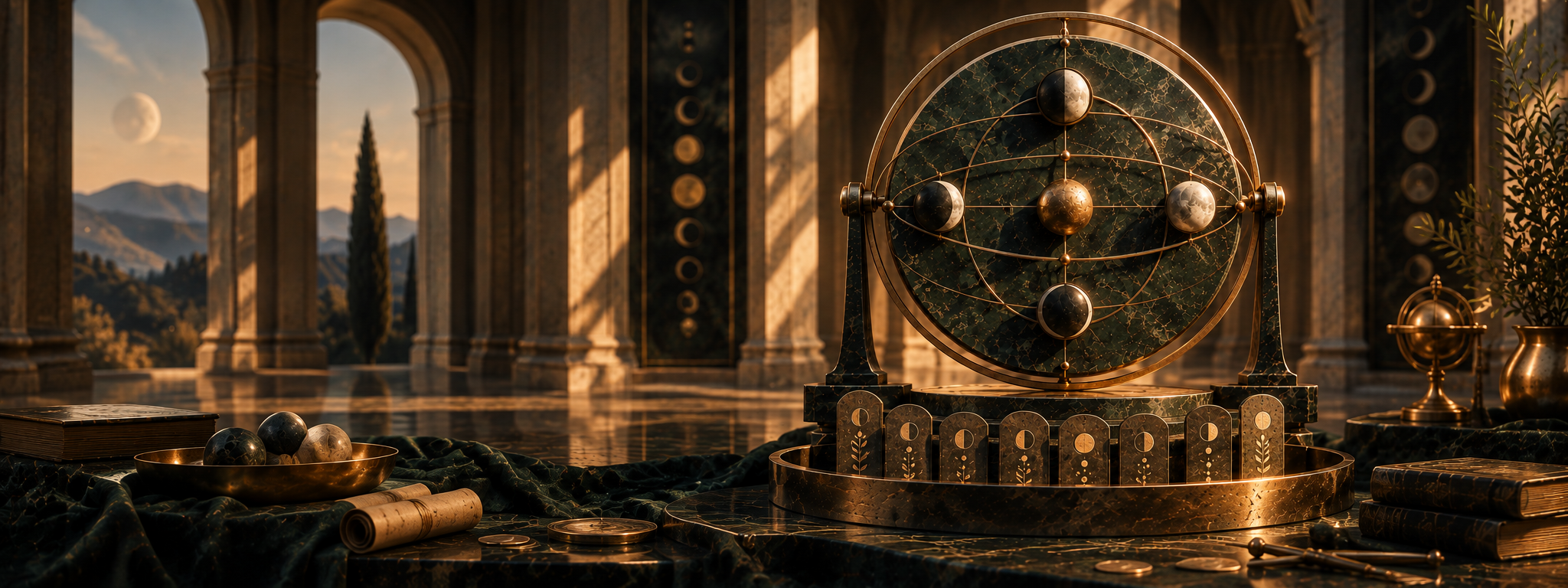
For a very long time, human beings have looked upward to understand time.
The moon is particularly difficult to ignore.
Unlike an invisible number changing on a clock, lunar change can be watched across the sky. The illuminated portion appears to grow, reach fullness, diminish and disappear before becoming visible again.
Human communities used such recurring celestial patterns in calendars, ritual life and the organization of time.
Women have also long associated the moon with menstruation, fertility and recurring bodily time.
But association is not the same thing as biological causation.
And cultural memory is not automatically scientific evidence.
The interesting question is therefore not whether we must choose between ancient memory and modern science.
The question is what each kind of evidence actually allows us to say.
Observation begins a question.
Evidence determines how far the answer can responsibly go.
01 · First, Separate the Questions
We are often asking several different things at once.
When someone asks whether women are connected to the moon, that sentence can hide several different questions.
Did historical cultures associate women, menstruation or fertility with lunar cycles?
Do some women observe recurring relationships between their menstrual onset and particular lunar phases?
Does a population-level statistical relationship exist between menstrual timing and the lunar cycle?
If such a relationship exists, what mechanism produces it?
And what meaning, if any, should humans give that relationship?
These are not interchangeable questions.
Historical evidence may help answer the first. Longitudinal observation may contribute to the second. Chronobiology and statistics are needed for the third. Mechanistic research is required for the fourth.
The fifth belongs partly to interpretation.
Diagram 01 · From Observation to Interpretation
Do not begin with the conclusion.
02 · Women Were Observers of Time
Repeated bodily experience creates its own archive.
Long before menstrual-tracking applications existed, a woman could notice recurrence.
She did not need a laboratory to know that bleeding had returned.
She could remember whether it returned before or after a familiar event, season or visible change in the sky.
Repeated observation does not automatically reveal cause.
But observation matters because many scientific questions begin when somebody notices that something appears to happen repeatedly.
The appropriate response to such an observation is neither automatic belief nor automatic ridicule.
It is documentation.
Observation · Feminine Renaissance Women's Groups
The reports are not all the same.
Within Feminine Renaissance women's groups, women have described recurring menstrual onset around different portions of the lunar cycle.
Some report a pattern around the new moon. Some describe a recurring relationship nearer another phase. Others report patterns that shift when their menstrual regularity changes.
That diversity is important.
It does not support a simple rule that every woman should menstruate at the full moon—or at any other single lunar phase.
Neither should these accounts be presented as a controlled scientific study. They are observations reported by women about their own bodies.
Their value at this stage is not that they prove the answer. Their value is that they sharpen the question.
03 · Two Approximately Monthly Rhythms
Similar duration makes comparison reasonable. It does not prove synchronization.
The synodic lunar cycle—from one new moon to the next—is about 29.5 days.
The menstrual cycle is also a circa-monthly biological rhythm, although individual cycle lengths vary and a woman's cycles need not remain identical throughout her life.
The similarity is striking enough to generate a legitimate scientific question.
But two oscillations having similar periods does not establish that one controls the other.
To demonstrate synchronization, researchers must examine the relationship between their timing across repeated cycles and determine whether the pattern exceeds what would be expected by chance.
Diagram 02 · Similar Period Does Not Mean Identical Phase
Internal
Menstrual
Rhythm
External
Lunar
Rhythm
Same neighborhood of duration ≠ same phase
Two recurring systems may have similar periods while drifting relative to one another, intermittently aligning, or showing no stable phase relationship.
04 · What Recent Research Found
The lunar question has not disappeared.
A 2024 Science Advances study analyzed two large datasets: 26,912 menstrual cycles from 2,303 European women and 4,786 cycles from 721 North American women.
The researchers reported evidence consistent with an internal circa-monthly timing mechanism influencing menstrual-cycle regularity.
They also found a weak but statistically significant relationship between menstrual timing and the 29.5-day lunar cycle.
But there is an important complication.
The phase relationship differed between the European and North American populations.
In other words, the study did not establish one universal lunar phase at which women menstruate.
The researchers themselves concluded that the findings require confirmation in larger populations and that the mechanisms remain to be clarified.
An Important Distinction
Evidence for a weak lunar influence is not evidence that every woman's cycle should begin at the same lunar phase.
Population association, individual synchronization and a universal biological rule are three different claims. Evidence for one does not automatically establish the others.
05 · Intermittent Synchronization Changes the Question
Perhaps we should not be searching only for permanent alignment.
Earlier longitudinal research has reported periods in which menstrual timing in some women appeared to synchronize intermittently with lunar cycles.
That possibility is conceptually different from claiming that all women permanently menstruate at the same lunar phase.
Two oscillating systems can move into and out of alignment.
If menstrual-lunar relationships are intermittent, then averaging many women together—or examining only a short interval in one woman—could conceal patterns that become more visible in long individual records.
This is one reason longitudinal observation matters.
06 · What We Cannot Yet Say
An open question should remain open.
Current evidence does not justify saying that every healthy woman should menstruate at the full moon.
It does not justify replacing full moon with new moon and making the same universal claim.
It does not yet establish a single mechanism by which lunar timing regulates human menstruation.
And it does not allow us to diagnose a woman's health from the lunar phase at which menstruation begins.
But neither does the evidence require us to declare the entire lunar question meaningless.
The scientifically responsible position is narrower and more interesting: a possible weak or intermittent relationship has been detected, while its strength, variability, mechanism and significance remain under investigation.
Diagram 03 · Keep the Layers Separate
Observation
A woman notices a recurring relationship in her own cycle.
Evidence
Research tests whether measurable relationships occur beyond individual anecdote.
Interpretation
We ask what the measured relationship might mean within a wider understanding of natural time.
Open Question
We identify what the available evidence still cannot resolve.
07 · Memory Before Mechanism
Cultural memory can preserve a question without preserving its explanation.
Human communities can observe recurring phenomena for generations without possessing modern instruments or modern biological explanations.
What is remembered culturally may therefore contain several layers at once: careful observation, symbolism, social practice, cosmology and later interpretation.
We should not collapse those layers.
An ancient association between woman and moon does not prove a modern physiological mechanism.
But neither should the absence of a known mechanism make us assume that every old observation was meaningless.
History deserves investigation.
Biology deserves measurement.
Interpretation deserves identification as interpretation.
08 · The Woman as Recorder
The next archive can begin with women documenting themselves.
One of the simplest things a woman can do is observe her own cycle over time.
Date of menstrual onset. Cycle length. Changes in regularity. Relevant reproductive transitions. And, if she is interested in the lunar question, the corresponding lunar phase.
Such records should not be used to diagnose disease or force a woman into an expected lunar pattern.
Their first value is simpler:
they transform memory into a record.
And once observations are recorded consistently, better questions become possible.
Formation Insight
Perhaps becoming a timekeeper begins not with mastering time, but with learning to notice recurrence.
The moon reminds us that visible change can be rhythmic. The menstrual cycle reminds us that the body also contains recurring time. Whether and how those two rhythms interact remains a scientific question.
We do not need to invent certainty in order to recover the art of observation.
Carry This With You
What have you observed repeatedly enough to begin recording?
Do you know the ordinary range of your own cycle?
Have you noticed periods of greater regularity or irregularity?
Have you ever compared your observations with lunar phases across many consecutive months rather than remembering only striking coincidences?
What changed when your pattern changed?
And can you remain curious about a pattern without forcing it to prove more than it actually does?
Observe what returns.
Record what changes.
Test what can be tested.
Name interpretation as interpretation.
And leave the unanswered question open.
Evidence Note
Research behind this Journal
The principal contemporary evidence discussed here comes from chronobiological research on menstrual-cycle timing. The 2024 Science Advances study found evidence for an endogenous circa-monthly timing system and a weak but statistically significant lunar influence, while also finding different phase relationships in European and North American datasets. Its authors state that the findings require confirmation and further mechanistic investigation.
Ecochard et al., Science Advances (2024) →Continue the Collection
From Biological Clock
to Living Calendar
The body is more than a biological clock. It is a living calendar of interacting rhythms, changing states, seasons, recovery, readiness and renewal.
Next Journal →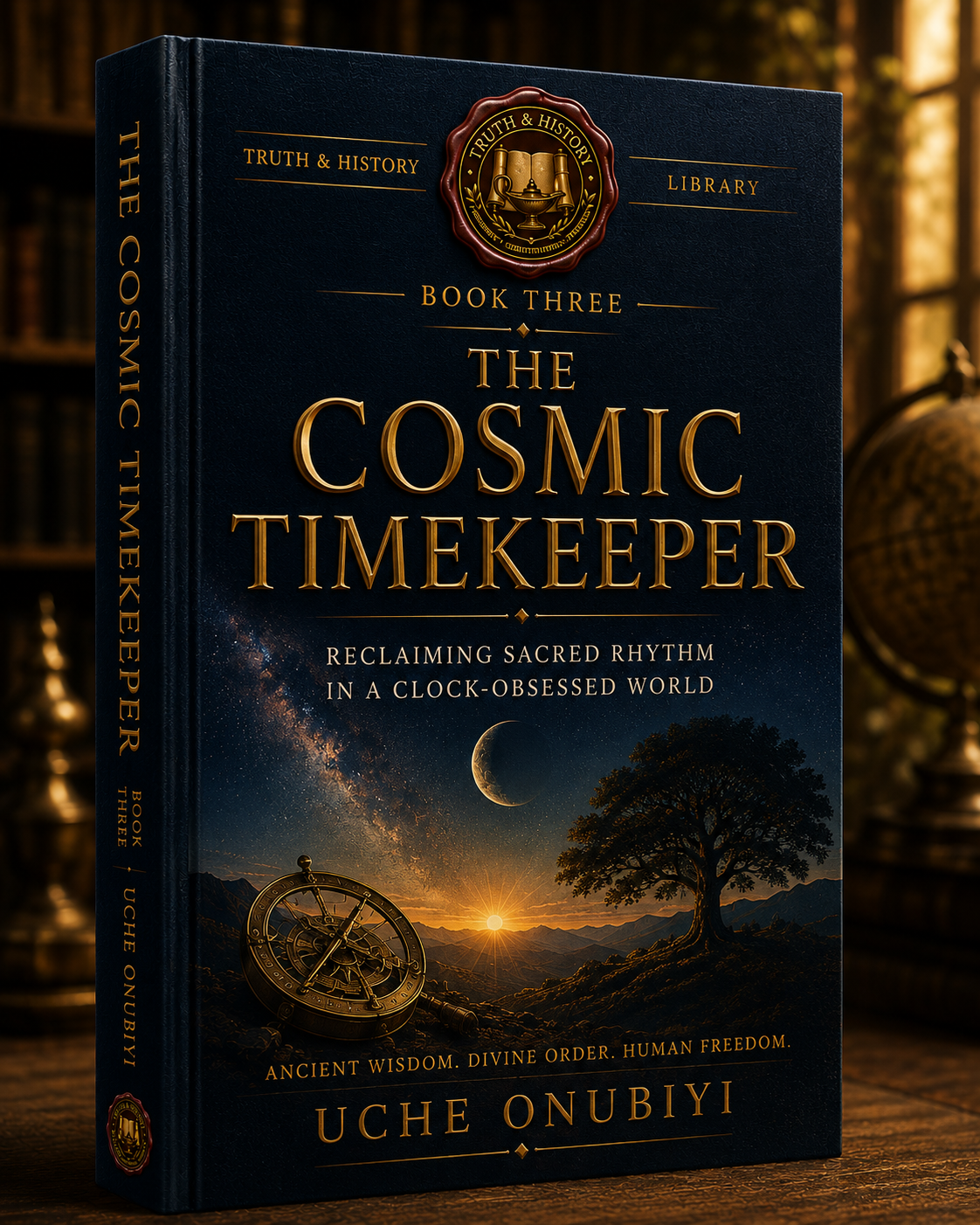
Read More
The Cosmic Timekeeper
Explore the wider relationship between natural rhythms, biological time, lunar and solar cycles, the clock and the human experience of recurring time.
Read the Book →