01
Planet
Climate instability, biodiversity loss, resource pressure and ecological disruption are changing the conditions within which societies must plan.
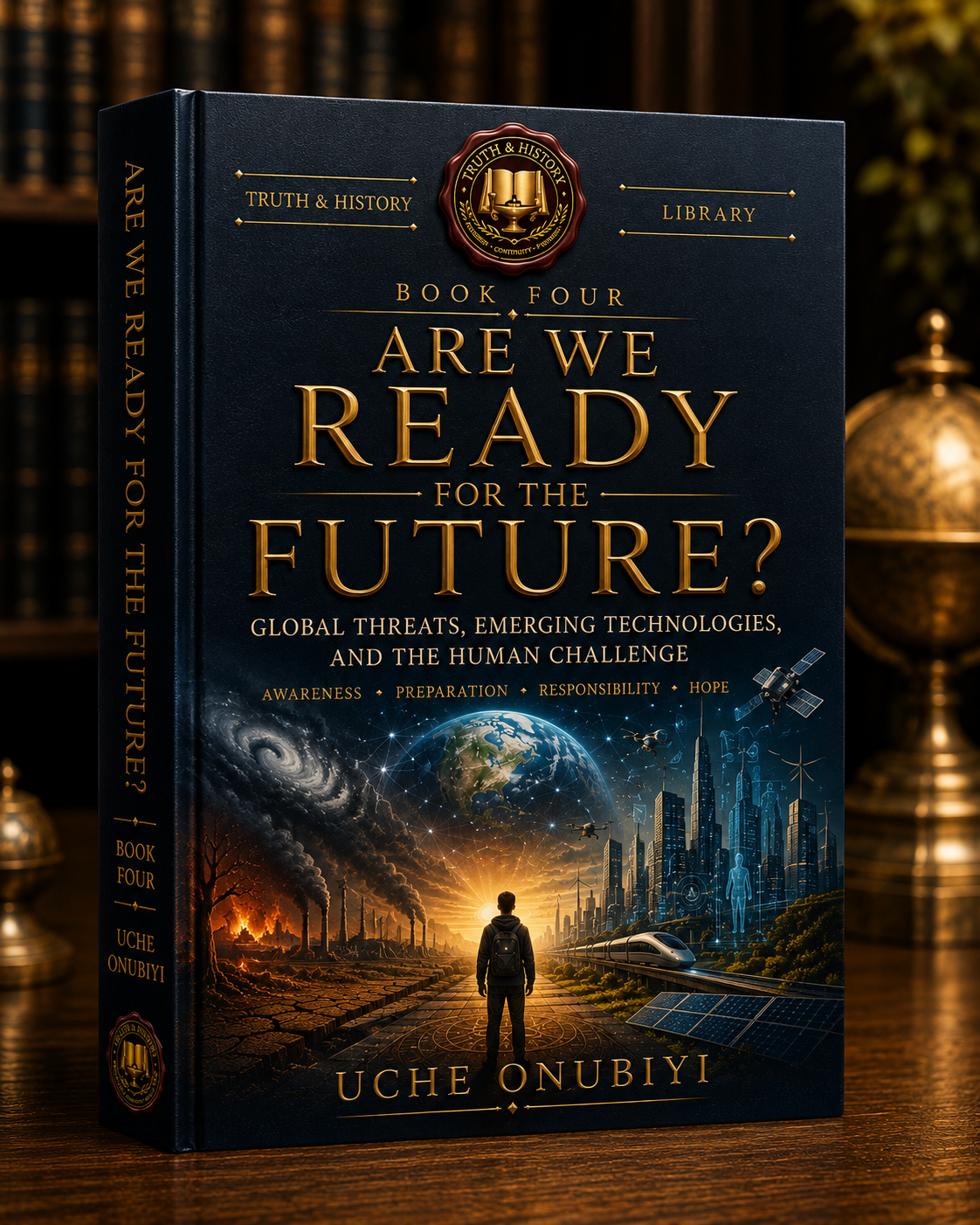
Truth & History Library · Book Four
Global Threats, Emerging Technologies, and the Human Challenge
An examination of a world gaining extraordinary technological power while confronting environmental, geopolitical, social and deeply human questions about what progress requires of us.
Uche Onubiyi
Share This
About the Book
Humanity is entering an era in which technological capability, environmental pressure and geopolitical uncertainty are developing simultaneously.
Artificial intelligence is transforming work and knowledge. Biotechnology is expanding what can be done with living systems. Synthetic media is complicating trust. Cyber systems connect societies while creating new forms of vulnerability.
Yet Are We Ready for the Future? is not simply a book about technology or global threats. Its deeper concern is the human being who must navigate them.
The central question is therefore not only whether humanity can build the future, but whether we are becoming capable of carrying the power we are creating.
The Human Challenge
Our tools are becoming more powerful.
Are we becoming more capable of using them wisely?
Five Forces Shaping the Future
01
Climate instability, biodiversity loss, resource pressure and ecological disruption are changing the conditions within which societies must plan.
02
Artificial intelligence, biotechnology, cyber systems and synthetic realities are expanding human capability faster than many institutions can adapt.
03
Geopolitical rivalry, weapons, information systems and contested narratives are reshaping how influence and security operate.
04
Access to opportunity, infrastructure, education and emerging technologies remains deeply uneven within and between societies.
05
Behind every technological question remains a human one: what kind of people will possess these new powers, and toward what ends?
Emerging Technologies
The question is no longer whether technology will alter human life. It already does. The harder question concerns the kind of human and institutional formation required to govern its consequences.
Work · judgment · knowledge · autonomy
Trust · perception · identity · truth
Infrastructure · security · interdependence
Life · health · modification · responsibility
The World Is Shifting
From stable roles toward continuous adaptation
From information scarcity toward information overload
From trusted perception toward synthetic media
From physical borders toward interconnected digital vulnerability
From observing life toward increasingly editing it
From managing continuity toward navigating uncertainty
Africa and the Future
Africa enters the emerging future carrying a profound paradox: enormous human and natural resources alongside persistent infrastructure gaps, inequality and uneven access to technological opportunity.
A young population can become extraordinary human capacity, but demographics alone do not create readiness. Education, infrastructure, institutional competence, technological access and meaningful pathways for participation matter.
The continent must therefore be considered not merely as a recipient of technologies designed elsewhere, but as a participant in defining what the future should become.
The Resource Paradox
Minerals, land, population and raw materials do not automatically produce resilient societies. The deeper resource is the ability to convert potential into knowledge, institutions, productive capability and human flourishing.
Readiness
The ability to distinguish capability from wisdom, information from truth and urgency from importance.
The capacity to learn, unlearn and reorganize when old assumptions no longer fit new conditions.
The willingness to consider consequences before power becomes action.
The capacity of people, institutions and societies to absorb disruption without losing their essential humanity.
The ability to envision futures beyond both technological utopia and permanent catastrophe.
A governing answer to the question of what progress is ultimately for.
The Human Paradox
Technology amplifies capability. It does not automatically supply purpose, restraint, responsibility or wisdom. Those remain formation questions.
Building Resilience
Learning, adaptability, discernment and responsibility.
Capacity to change before disruption becomes collapse.
Institutions able to anticipate, coordinate and protect the public good.
Trust, inclusion, infrastructure and shared capacity to respond.
Beyond Progress
The ability to make something possible does not answer whether it should be pursued, who should benefit, what consequences are acceptable or what kind of world the innovation is helping to create.
The future is not only a destination we are approaching. It is a consequence we are producing.
The Question Remains
Readiness is not knowing exactly what will happen. It is developing the human, institutional and civilizational capacity to meet what comes without surrendering responsibility, wisdom or our humanity.
About the Author
Uche Onubiyi is an author and researcher whose work examines human formation, history, emerging change and the relationship between knowledge and responsibility. Her writing asks what kind of human beings and institutions are required for the worlds we are creating.
About the Coordinator →Next Book
Vol. One · The Human We Have Forgotten