
Before there were clocks on walls, calendars on phones or notifications telling us when one day had become another, the human body was already keeping time.
Hunger returns. Sleep arrives. Hormones rise and fall. Fertility changes. The body repairs, prepares, releases and begins again.
In women of reproductive age who menstruate, one of the most visible expressions of this rhythmic biology is the menstrual cycle.
Menstruation is therefore more than a date marked on a calendar. It belongs to a coordinated physiological process involving the brain, ovaries, hormones and uterus.
Its timing varies between women. It can also vary within the same woman across different periods of life.
Yet beneath that variation is something important: the body is rhythmic.
The menstrual cycle does not simply count time. It demonstrates that the body participates in time through change.
01 · The Body Is Not a Mechanical Clock
Rhythm is not the same thing as mechanical repetition.
A mechanical clock is valuable because it is expected to repeat the same measurement consistently.
Biological systems are different.
They are rhythmic, but they are also responsive.
Age, reproductive stage, pregnancy, breastfeeding, stress, illness, nutrition, hormonal conditions and other factors can affect menstrual timing.
Variation therefore does not mean that rhythm is absent.
It reminds us that living time is expressed through a living system rather than a machine.
Diagram 01 · The Menstrual Rhythm
A cycle of changing physiological states
Menstruation
The uterine lining is shed.
Follicular Phase
Follicles develop as the body prepares for possible ovulation.
Ovulation
An egg is released from the ovary.
Luteal Phase
The body prepares either for implantation or another cycle.
This diagram is deliberately schematic. Cycle length and phase length vary, and not every menstrual cycle includes ovulation.
02 · Menstruation Is Part of a Cycle
The bleeding is visible. The rhythm is larger.
Menstruation receives attention because it is the most visible part of the cycle.
But menstruation is not the whole cycle.
Across the menstrual cycle, hormonal changes coordinate processes involving follicular development, ovulation in ovulatory cycles, changes in the endometrium and preparation for either implantation or another menstrual period.
The body is not doing the same thing every day.
This matters to our understanding of time.
A month can look uniform on a calendar while being physiologically differentiated within the body.
Women Were Observing Before We Were Measuring
Observation deserves to be recorded before it is interpreted.
Within Feminine Renaissance women's groups, women have described recurring relationships between the onset of their menstruation and particular portions of the lunar cycle.
Some report menstruating repeatedly around the new moon. Others notice a recurring relationship nearer other lunar phases. Some describe a pattern that remains recognizable for long periods and then changes when their menstrual regularity changes.
These reports are observations from women about their own bodies. They are not, by themselves, evidence that all women synchronize with the moon or that the moon causes menstruation.
But the distinction works in both directions: lack of proof for a universal rule does not require us to erase individual longitudinal observations.
First observe. Then document. Then ask what the evidence can actually support.
03 · The Moon Question
Myth, memory, coincidence—or biological echo?
The similarity between the length of the lunar month and a commonly cited menstrual-cycle length has invited comparison for a very long time.
But resemblance in duration does not establish biological synchronization.
Scientific studies have not demonstrated that every woman menstruates at one particular lunar phase. Research has produced mixed findings: some datasets show little or no relationship, while some longitudinal work has reported intermittent associations in particular individuals.
That leaves us with a more interesting question than "Do all women menstruate with the moon?"
Can an individual woman's menstrual rhythm show a recurring relationship with lunar timing for some period of her life—and under what conditions might that relationship strengthen, weaken or shift?
That question remains open enough to investigate rather than settle by either romantic assertion or premature dismissal.
Diagram 02 · Two Rhythms, One Question
Menstrual rhythm and lunar rhythm should not be drawn as though they are automatically locked together.
Body
Menstrual
Rhythm
Environment
Lunar
Rhythm
Possible relationship?
Investigate the relationship without assuming either perfect synchronization or complete independence.
04 · What Changes a Rhythm?
A living rhythm responds to a living body.
Menstrual timing is not insulated from the rest of human physiology.
Reproductive stage, endocrine conditions, pregnancy, breastfeeding, substantial physiological stress and various health conditions can alter cycle characteristics.
This is another reason individual observations matter.
A woman who has recorded her cycle for years may notice not only recurrence, but change.
The change itself becomes information.
It does not diagnose its cause. But it can tell her that the pattern she knows has changed and may deserve attention.
Evidence
Menstruation belongs to a hormonally regulated reproductive cycle. Cycle characteristics vary both between women and across a woman's life.
Observation
Some women report recurring relationships between their menstrual onset and particular lunar phases. Such observations can be documented without being universalized.
Open Question
Whether, when and through what mechanisms lunar timing may weakly influence menstrual timing remains an area requiring careful investigation.
05 · Release Is Part of Rhythm
The cycle contains both preparation and letting go.
Menstruation is associated with the shedding of endometrial tissue when pregnancy has not occurred.
Biologically, that process should not be turned into a simplistic spiritual metaphor.
But as a formation reflection, it presents an intriguing pattern: living systems are not defined only by accumulation.
Formation can involve building, maintaining, releasing and beginning another sequence.
A culture obsessed with accumulation may find release difficult to understand.
Yet not everything that was prepared must be carried forever.
Diagram 03 · Formation Insight
Rhythm · Release · Renewal · Preparation · Return
This is a Formation Insight, not a medical description of the menstrual cycle. It draws a wider human reflection from the existence of recurring biological processes.
06 · Return Is Not Going Backward
Recurrence can contain change.
From the outside, recurrence can look like repetition.
Another menstruation. Another month. Another beginning.
But the woman entering the next cycle is not literally the same biological system frozen in time.
She is older. Her circumstances may have changed. Hormonal conditions can change. Health can change. Reproductive capacity changes across the lifespan.
The cycle returns while the person continues through time.
That is why cyclical time and developmental time do not have to be enemies.
We can return and still become.
The Woman as Timekeeper
Perhaps the body remembers something the calendar can easily hide:
Time is not merely passing.
Something is always changing within it.
Carry This With You
What might you discover if you observed your rhythm before trying to interpret it?
What patterns in your body have remained relatively stable?
Which have changed?
What was happening in your life or health when they changed?
Are there rhythms you have noticed repeatedly but never recorded?
And what would become visible if women's long-term observations of their own bodies were documented carefully rather than dismissed or universalized?
The body releases.
The body renews.
The rhythm returns.
And the woman continues becoming.
Continue the Collection
The Forgotten
Intelligence of Rest
What if rest is not the interruption of productive life, but one of the processes that makes sustained life possible?
Next Journal →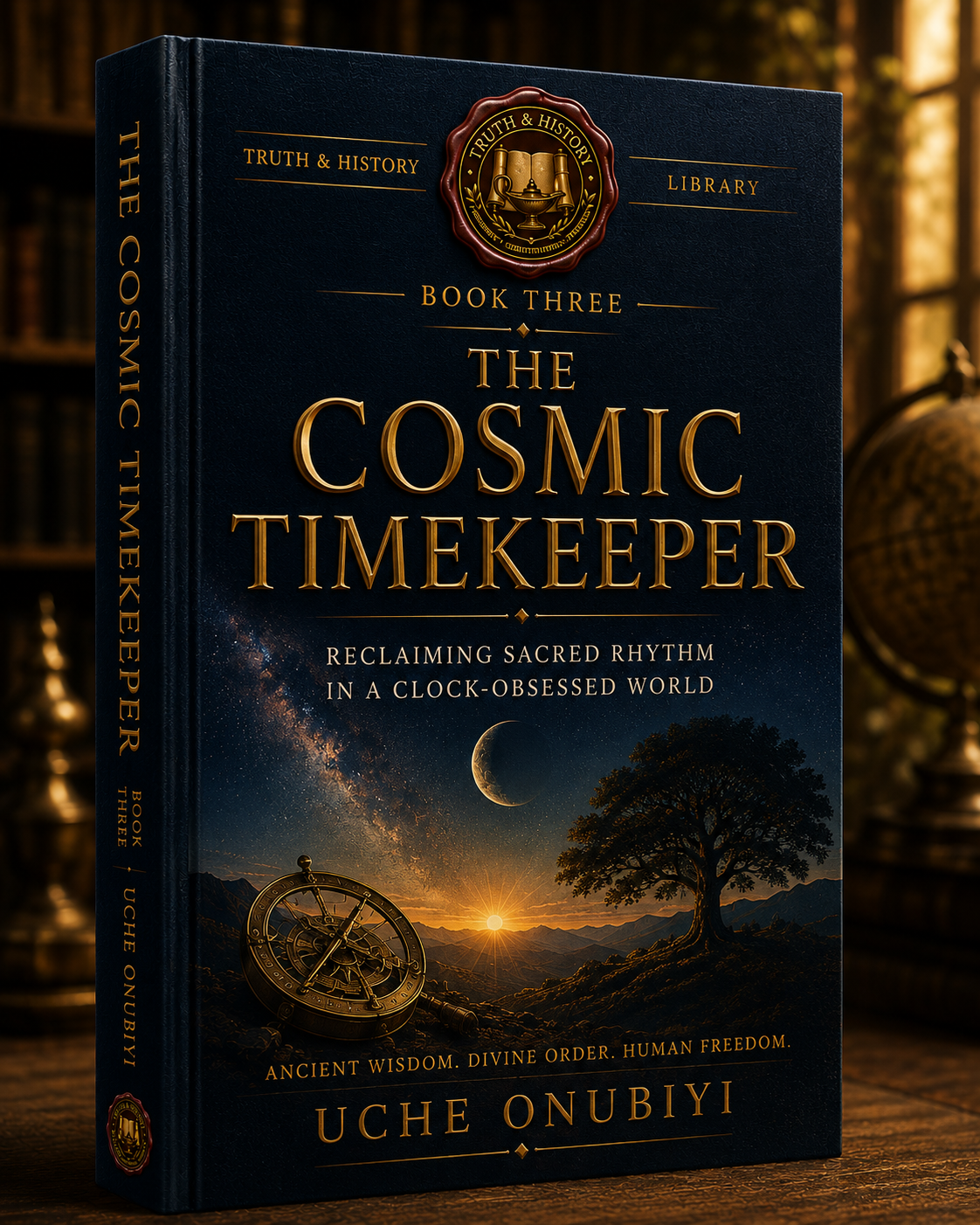
Read More
The Cosmic Timekeeper
Explore the wider relationship between biological rhythm, natural cycles, measured time and the human experience of living within recurring patterns.
Read the Book →