
A clock can measure how long something has existed.
It cannot tell us whether that thing has finished becoming.
This distinction is easy to forget because modern life has become extraordinarily skilled at measuring duration. We count minutes, hours, weeks, months and years. We set deadlines. We estimate completion dates. We divide processes into schedules and place them inside calendars.
Measurement is useful.
But life contains another kind of knowledge.
The womb makes that knowledge visible.
Gestation is not merely the passage of time. It is formation occurring within time.
The clock can tell us how long something has been carried. It cannot, by itself, tell us whether what is being carried is ready to emerge.
01 · Time Is Not the Same as Formation
Duration measures passage. Formation describes change.
Two things can exist for the same length of time and yet undergo very different degrees of development.
A person can spend years receiving information without developing wisdom. A relationship can continue for decades without becoming mature. An institution can survive for a century without learning how to regenerate itself.
Elapsed time alone does not produce maturity.
Formation requires processes.
Something must be received. Conditions must support its development. Structures must differentiate. Capacity must increase. What begins in one state must gradually become capable of another.
This is why the question “How long?” is not always enough.
We must also ask: “What has been formed?”
A Different Measure
The clock measures duration.
Formation measures transformation.
One asks how much time has passed. The other asks what the passage of time has made possible.
02 · Gestation Has Sequence
Life does not merely wait. It develops.
Gestation can look like waiting from the outside.
But inside, extraordinary changes are occurring.
Development unfolds through sequences. Structures emerge, differentiate and become increasingly capable of sustaining what comes next.
One stage prepares conditions for another.
This means that time is not simply an empty container through which development passes.
Time gives process room to unfold.
The distinction matters because modern culture often treats waiting as the absence of action. If nothing dramatic can be seen, we may assume that nothing important is happening.
Gestation contradicts that assumption.
Some of the most consequential formation happens before manifestation.
03 · Hidden Does Not Mean Empty
Visibility is not the beginning of existence.
Modern systems often reward what can be displayed, measured, announced and counted.
We celebrate launches more readily than preparation. Performance more readily than practice. Outcomes more readily than the long formation that made those outcomes possible.
Yet much of life begins in hiddenness.
Roots develop below the ground before a mature plant becomes visible. Understanding may deepen quietly before a person can articulate it. Character is often formed through repeated choices that no audience witnesses.
Hidden formation is not automatically good, nor does every delay indicate meaningful development.
But neither should invisibility be mistaken for absence.
The womb teaches us to take seriously what is becoming before it can yet stand in public.
Biology · Metaphor · Interpretation
Pregnancy and fetal development are biological processes and should be discussed as such when biological claims are being made.
In this Journal, gestation also functions as a formation metaphor. The biological womb does not prove that every psychological, social or spiritual process follows the same developmental pattern.
The interpretive insight is narrower: living formation often requires conditions, sequence, development and sufficient time before emergence.
04 · The Violence of Premature Emergence
Not everything should be made visible as soon as it begins.
Our age has developed an unusual relationship with immediacy.
Ideas can be published moments after they are conceived. Opinions can be broadcast before they have been examined. People can be given visibility before they have developed the capacity to carry what visibility demands.
Speed has enormous advantages.
But speed can also expose what has not yet developed the structures necessary for survival.
There is a difference between suppression and protection.
Suppression prevents something from becoming what it could be.
Protection creates conditions in which becoming can continue until greater capacity has formed.
The feminine capacity to protect is therefore not merely defensive.
Protection can be developmental.
05 · Readiness Cannot Be Reduced to a Deadline
A date can arrive before maturity does.
Deadlines are necessary in many areas of life. Without them, responsibilities can remain indefinitely unfinished.
But a deadline and readiness are not identical.
A person may reach a legal age without reaching emotional maturity. A student may complete a course without mastering its subject. A leader may receive a title before developing the character required to carry authority.
Chronology tells us that a threshold has been reached.
Formation asks whether capacity has developed to meet it.
This distinction is uncomfortable because readiness is more difficult to measure than dates.
But human life cannot be made truthful simply by measuring what is easiest to count.
06 · What the Female Body Makes Visible
The woman does not create time. Her body can make formation within time unusually visible.
This distinction matters.
To speak of the woman as timekeeper is not to claim that every woman must become a mother, that reproduction defines womanhood, or that women possess some automatic mystical knowledge unavailable to men.
It is to notice that the female body can make certain temporal realities difficult to ignore.
Cycles change. Fertility has seasons. Pregnancy requires development. Birth marks transition. Recovery takes time. Reproductive life itself changes across the lifespan.
The body reveals something civilization repeatedly tries to forget:
not every season exists for the same purpose.
07 · The Womb as Formation Architecture
Receiving is only the beginning.
The feminine architecture we have been recovering contains several connected capacities: reception, nurture, protection, relationship, carrying, regeneration and maturation.
Gestation helps us see why they belong together.
What is received must sometimes be carried.
What is carried requires an environment.
An environment must protect without imprisoning.
Nurture must change as development changes.
And eventually, what has been protected must become capable of emergence.
Formation therefore cannot remain permanently enclosed.
The purpose of the womb is not indefinite containment.
It is mature emergence.
The womb does not ask only,
“How much time has passed?”
Formation asks, “What is ready?”
08 · Birth Is a Threshold, Not the End
Emergence begins another relationship with time.
Birth can look like completion because something previously hidden has become visible.
But birth does not complete formation.
It changes its environment.
What was formed for one condition must now develop capacities appropriate to another.
The same is true of many human beginnings.
Publishing the book is not the end of becoming an author. Opening an institution is not the end of building it. Marriage is not the completion of relationship. Receiving responsibility is not the same as learning how to carry it.
Manifestation is a threshold.
What emerges must now learn how to live.
Formation Insight
Perhaps some things in your life do not need more speed.
They may need better conditions.
They may need protection from premature exposure.
They may need nourishment rather than pressure.
They may need another stage of development before the next threshold can be carried responsibly.
And some things may already be mature enough that continued waiting has become fear rather than gestation.
Wisdom lies in learning the difference.
Carry This With You
What are you measuring by time that should be examined by formation?
What are you trying to bring into visibility before it has developed the capacity to survive there?
What appears inactive but may actually be forming beneath the surface?
Where have you confused age, duration or position with maturity?
What are you continuing to protect even though its season of emergence has arrived?
And what would change if you began asking not only, “How long?” but also, “What has become ready?”
The clock counts the passage.
The womb carries the process.
Maturity reveals what time has formed.
Continue the Collection
Menstruation:
The Body That Remembers Rhythm
The menstrual cycle makes visible something the mechanical clock can easily hide: the body participates in time through recurring biological change.
Next Journal →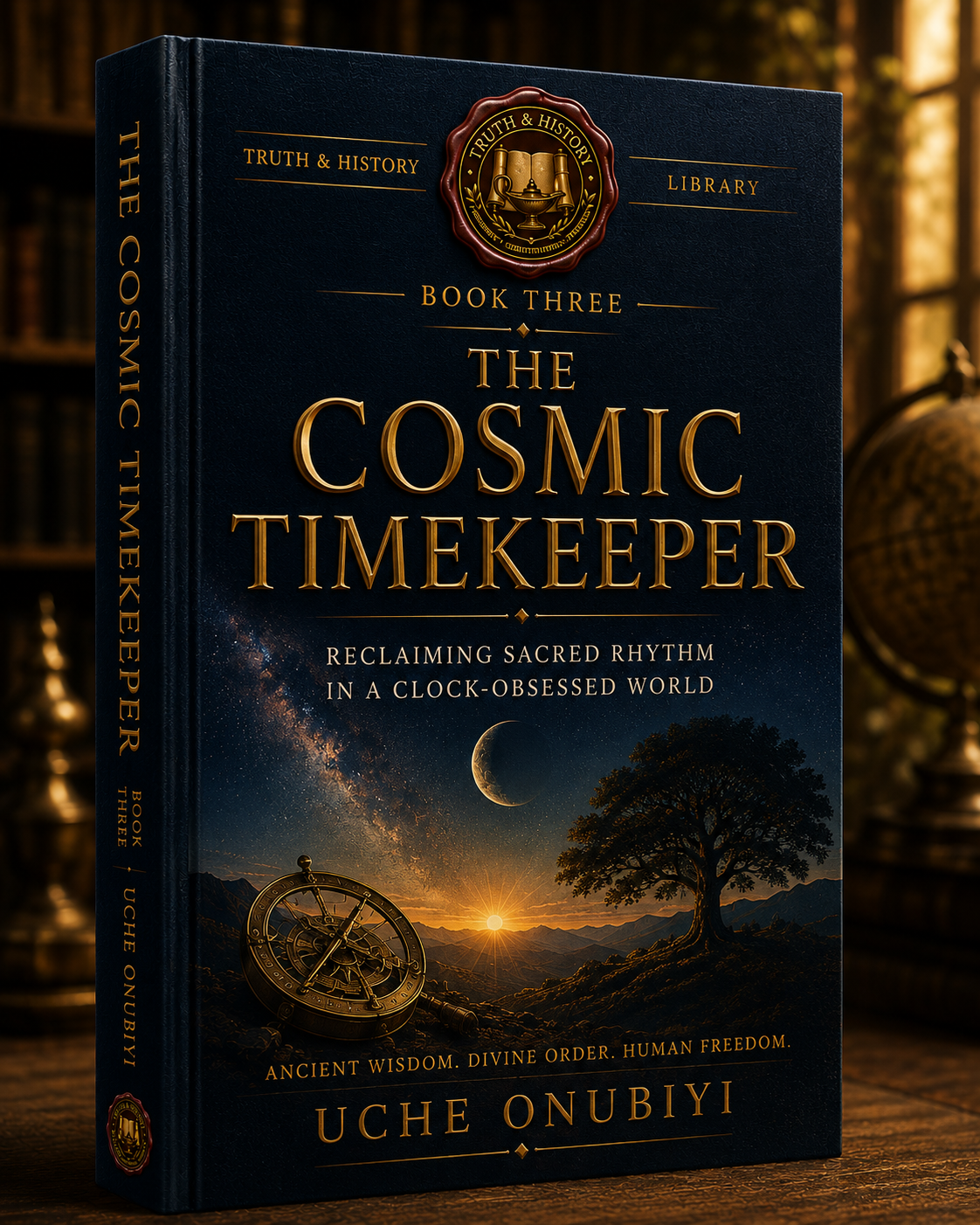
Read More
The Cosmic Timekeeper
Continue the wider exploration of measured time, living rhythms, cycles, seasons and the difference between counting time and learning how to live within it.
Read the Book →