
Modern life teaches us to ask the time constantly.
What time is the meeting? What time does work begin? When is the deadline? How many hours remain? How quickly can the task be completed? How much can be produced before the day ends?
These questions are not meaningless. Measured time makes coordination possible. Clocks allow strangers, institutions, cities and entire societies to synchronize activity with extraordinary precision.
But another question is rarely asked:
What happens when the clock stops serving human life and human life begins serving the clock?
That distinction matters because time can be measured without being fully understood.
A clock can tell us that sixty minutes have passed. It cannot tell us whether something has matured.
A calendar can tell us that a particular date has arrived. It cannot tell us whether a person, relationship, community or idea is ready for what comes next.
Measurement tells us how much time.
Living asks another question: What kind of time is this?
01 · Before Time Became Primarily a Number
Human beings learned time from change.
Long before the mechanical clock organized daily life, human beings encountered time through recurring changes in the world around them.
Light appeared and disappeared. Shadows moved. The moon changed appearance. Seasons altered temperature, vegetation and rainfall. Plants germinated and matured. Animals migrated or reproduced at particular times. Human bodies slept, woke, bled, conceived, gestated, birthed, matured and aged.
Communities developed ways of observing, naming and organizing these recurring patterns. Different cultures created different calendars, rituals and systems of reckoning, but the underlying problem was shared: human beings needed ways to locate themselves within recurring change.
Time, in this sense, was not merely something outside the human being.
It was encountered through relationship: between body and light, planting and season, community and memory, birth and generation, activity and rest.
Evidence · Interpretation
The existence of biological rhythms and historical systems of astronomical and seasonal timekeeping can be studied as evidence. The meanings societies attached to those rhythms belong to history, culture and tradition. The claim that recovering awareness of rhythm can contribute to human formation is an interpretation. These categories should not be collapsed into one another.
02 · The Great Abstraction
Eventually, time became increasingly detachable from place.
Mechanical timekeeping did something remarkable. It made increasingly precise coordination possible without requiring people to look at the sun, observe a shadow or interpret the condition of the season.
Over time, standardized time became essential to transport, commerce, industry, administration and modern communication. This was not simply a loss. It was also an extraordinary human achievement.
The problem begins when an instrument of coordination becomes the primary metaphor through which life itself is understood.
Then efficiency can begin to replace maturation. Speed can be mistaken for progress. Availability can be mistaken for capacity. Productivity can be mistaken for fruitfulness.
A machine can be accelerated.
A living process cannot always be accelerated without changing what is being formed.
The clock is an extraordinary servant.
It becomes dangerous when we ask it to explain life.
03 · The Body Did Not Become Mechanical
The schedule changed. The organism did not.
Human beings can organize themselves according to clock time, but the body continues to operate through interacting biological rhythms.
Sleep and wakefulness do not become irrelevant because a deadline exists. Recovery does not disappear because the calendar is full. Hunger, fatigue, hormonal activity, maturation and aging do not negotiate with our productivity systems in the way a digital schedule does.
This does not mean that every bodily feeling should become an authority. Nor does it mean that natural rhythms are perfectly regular.
Bodies vary. Circumstances vary. Health, age, environment, pregnancy, caregiving, work, stress and many other factors can affect how rhythms are experienced.
The point is simpler: the human organism remains rhythmic even inside a culture organized by clocks.
04 · Why This Question Matters for Women
Some forms of time are difficult to hide from the female body.
The female body can make cyclical and developmental time unusually visible.
Menstruation, fertility, pregnancy, postpartum recovery, lactation, perimenopause, menopause and aging are not experienced identically by all women. Some women do not experience several of these processes at all.
Yet together they make an important point visible: embodied life is not infinitely interchangeable from one season to another.
A body can enter a different season while the surrounding system continues to demand identical output.
This tension is one reason the question of time matters to the Feminine Renaissance. The issue is not that women belong to nature while men belong to clocks. That would simply create another false division.
The deeper question is whether a civilization can make room for the rhythms required by living beings at all.
05 · Chronos and Kairos
Not every question about time is asking for a number.
One useful distinction found in Greek language and later reflection is between chronos and kairos.
Chronos concerns time that can be counted, ordered and measured. Kairos concerns the fitting, appointed or opportune moment.
We need both.
Chronos asks: What time is it?
Kairos asks: What is this the time for?
The first can place an appointment at three o'clock. The second asks whether a relationship is ready for a conversation, whether a seed is ready for harvest, whether grief has been given room, whether a person is prepared for responsibility, whether a community has reached a moment that requires action.
Human wisdom requires more than knowing the hour.
It requires learning to recognize the season.
06 · Recovery Is Not Rejection
We do not need to destroy the clock.
Recovering natural time does not require abandoning modern life, rejecting technology or pretending that earlier societies lived in perfect harmony with nature.
It means restoring proportion.
The clock can coordinate our meetings without defining our worth.
The calendar can organize our responsibilities without convincing us that every season should produce the same result.
Technology can extend what human beings can do without becoming the authority that tells us what human beings are.
The question is not whether we use measured time.
The question is whether we still remember how to recognize living time.
Formation Insight
Formation has a time that cannot always be commanded.
A seed can be placed in the ground at a chosen hour. Germination cannot simply be ordered to happen immediately.
A child can be taught information quickly. Maturity cannot be downloaded.
A decision can be made in a moment. Becoming the kind of person capable of carrying that decision may require years.
This is where natural time becomes more than a discussion about calendars. It becomes a discussion about formation.
Life unfolds through processes that must be participated in, not merely scheduled.
Carry This With You
Where has measured time become the master of your living time?
Where are you demanding constant productivity from a season that may require restoration?
What are you trying to accelerate simply because waiting feels unproductive?
Which rhythms of sleep, body, relationship, reflection or rest have become invisible beneath your schedule?
And where might the clock need to return to its proper place: not as your master, but as your tool?
To recover natural time is not to return to the past. It is to remember that life has rhythms the clock did not create.
Continue the Collection
The Feminine Does Not
Move in a Straight Line
Living systems repeatedly challenge the idea that all meaningful movement is linear. Return, recurrence and formation can belong to the same journey.
Next Journal →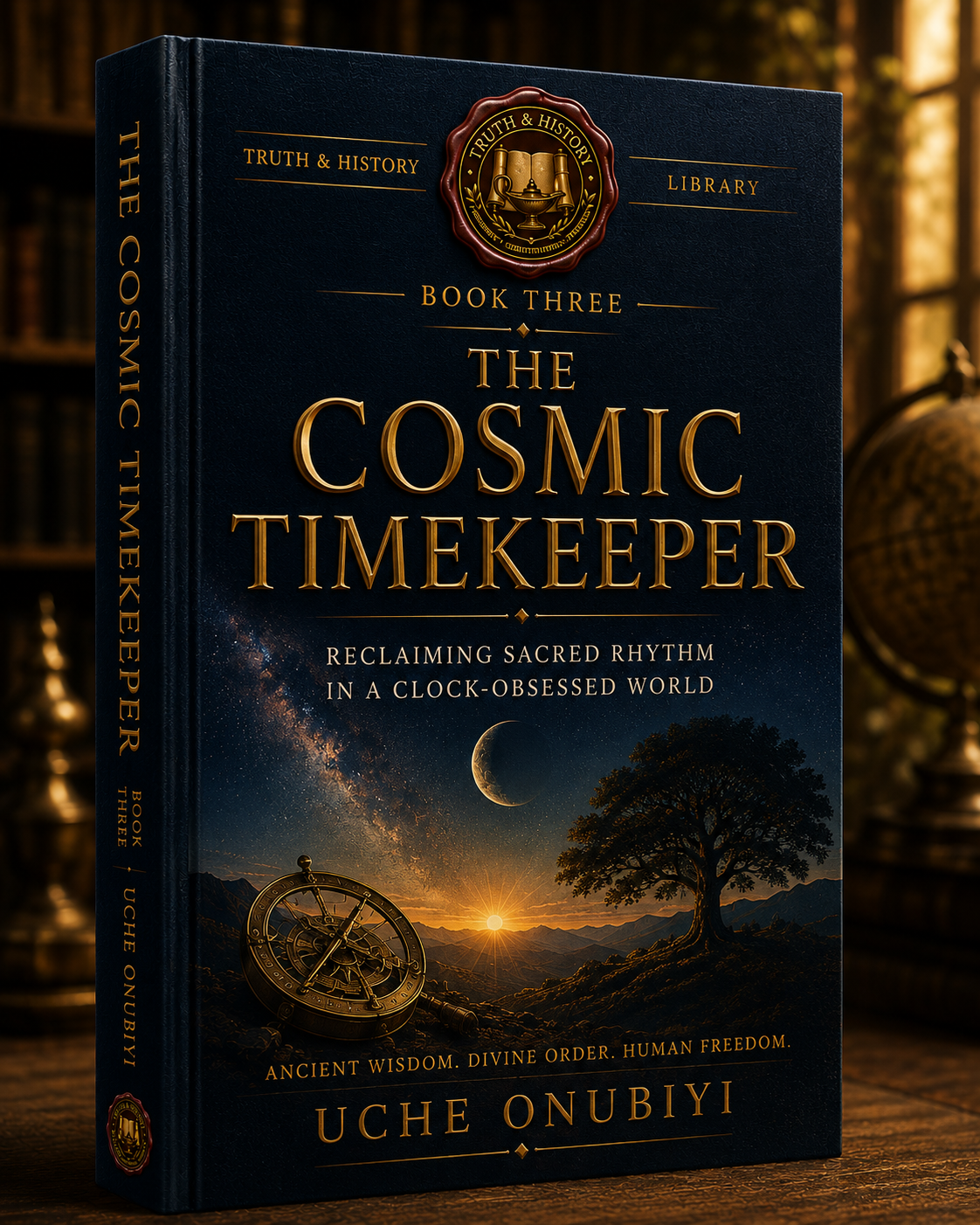
Read More
The Cosmic Timekeeper
Explore the wider investigation into clocks, calendars, natural rhythms, cosmic cycles and humanity's relationship with time.
Read the Book →