
We have become accustomed to drawing progress as a line.
There is a beginning. Then there is movement forward. Each step is expected to take us farther from where we started and closer to a clearly defined destination.
The line is useful. It allows us to measure distance, sequence events, organize projects and tell stories with a beginning, middle and end.
But living systems repeatedly challenge the idea that all meaningful movement is linear.
Day returns after night. Seasons return. Sleep returns. The body repeatedly moves through activity and restoration. Seeds become plants that produce seeds. Generations emerge from generations.
Return is everywhere.
Yet return does not necessarily mean that nothing has changed.
Life often returns to familiar places carrying something that was not there before.
01 · The Line and the Cycle
Measurement prefers the line. Life repeatedly reveals the cycle.
Linear time helps us place one event after another. Yesterday precedes today. Childhood precedes adulthood. A meeting begins and eventually ends.
Cyclical time draws our attention to recurrence: patterns that return, processes that repeat and rhythms through which life is sustained.
These are not competing realities.
A year moves forward and contains recurring seasons. A person grows older while returning to sleep each night. Generations move through history while birth repeatedly introduces new beginnings.
Linear movement and cyclical recurrence can exist at the same time.
The more useful image may therefore be neither a simple line nor a closed circle.
It may be the spiral.
The Spiral
The spiral returns without returning to exactly the same place.
It carries recurrence and movement together. Something is revisited, but it is revisited from another position, with another layer of experience, memory or maturity.
02 · Gestation Is Not a Straight Line
Formation includes periods when visible progress is not the point.
Gestation offers a powerful example.
Something can be developing profoundly while remaining largely hidden from view. Formation is taking place, but the process cannot be judged only by what has become externally visible.
This principle extends beyond pregnancy.
Ideas gestate. Skills develop through repetition. Trust forms over time. Understanding may require revisiting the same question repeatedly before something once known intellectually becomes understood more deeply.
A culture obsessed with visible output can misread such periods as inactivity.
But hidden does not mean inactive.
Waiting does not always mean stagnation.
Repetition does not always mean failure.
03 · Return Is Not Necessarily Regression
Sometimes we return because another layer is ready to be formed.
We often imagine growth as leaving old things behind.
Sometimes that is necessary. But mature formation can also involve returning to an old question, memory, relationship, place or responsibility with capacities we did not possess the first time.
The question may look familiar.
The person encountering it is not.
This is why recurrence should not automatically be interpreted as going backward.
A spiral passes a familiar direction while continuing its movement.
Evidence · Pattern · Interpretation
Recurring biological and environmental rhythms can be observed and studied. Human societies have also developed many cultural, philosophical and religious interpretations of cycles.
The spiral used here is a formation metaphor. It should not be treated as proof that every human experience follows one universal cyclical law.
Some processes are cyclical. Some are irreversible. Some are linear. Many contain more than one pattern at once.
04 · The Feminine Principle and Formation
The feminine makes room for processes that cannot be forced into immediate manifestation.
Within The Feminine Renaissance, the feminine is not simply a synonym for woman.
It describes capacities necessary for life and formation: receiving, carrying, nurturing, protecting, relating, regenerating and bringing life toward maturity.
These capacities are significant precisely because formation takes time.
To receive something is not the same as immediately expressing it.
To carry something is to remain in relationship with it through development.
To nurture is to respond to changing needs across stages.
To regenerate is to allow life to emerge again after depletion, damage or completion.
The feminine principle therefore confronts a culture that recognizes only forward motion, visible production and immediate results.
05 · Women and the Experience of Cyclical Time
The female body can make recurrence unusually visible.
Menstrual cycles are one obvious example, but they should not be made to carry more meaning than the evidence supports.
Menstrual cycles vary between individuals and across a lifetime. Not every woman menstruates, and womanhood cannot be reduced to reproductive biology.
Yet the recurring cycle provides one embodied reminder that sameness is not the only form of continuity.
Pregnancy makes another dimension visible. Development unfolds through stages. Birth is not produced simply because a date has been written on a calendar.
Menopause makes another transition visible again: the body does not remain in one reproductive season indefinitely.
The significance is not that women are trapped inside cycles.
It is that embodied life can make it difficult to maintain the illusion that every season should function identically.
06 · Chronos and Kairos Revisited
A schedule can identify an hour. Wisdom must recognize a moment.
Journal Two introduced the distinction between chronos — measurable time — and kairos, the fitting or opportune moment.
Here the distinction becomes important for formation.
Chronos can tell us how long someone has studied.
It cannot, by itself, tell us whether knowledge has become wisdom.
Chronos can count the years of a relationship.
It cannot tell us whether trust has matured.
Chronos can identify a birthday.
It cannot guarantee maturity.
The clock measures duration. Formation asks what has happened within that duration.
07 · The Violence of Permanent Forward Motion
A living system cannot remain in expansion forever.
Modern language often celebrates continuous growth.
More output. More speed. More reach. More activity. More visibility. More expansion.
But living systems also require maintenance, repair, dormancy, restoration and reorganization.
Rest is not the opposite of formation.
Pruning is not the opposite of growth.
Completion is not the opposite of beginning.
Sometimes the next movement forward begins with a return to what sustains life.
Formation Insight
The mature question is not simply, “Am I moving forward?”
It may be:
What is being formed in this season?
What needs to be carried rather than rushed?
What am I encountering again that I am now capable of meeting differently?
What needs to end so that regeneration can begin?
What looks like repetition but is actually another turn of the spiral?
Carry This With You
What if you are not back where you started?
What issue has returned in your life that you immediately interpreted as failure?
What can you see now that you could not see the first time?
Where are you forcing visible progress when something may still be gestating?
What season has completed its work and now needs permission to end?
And what might become possible if you stopped demanding that every meaningful journey look like a straight line?
The cycle returns.
The spiral remembers.
Formation carries the difference forward.
Continue the Collection
The Womb Knows Something
the Clock Does Not
A clock can measure duration. But gestation reveals another dimension of time: formation, sequence, readiness and the hidden processes that make mature emergence possible.
Next Journal →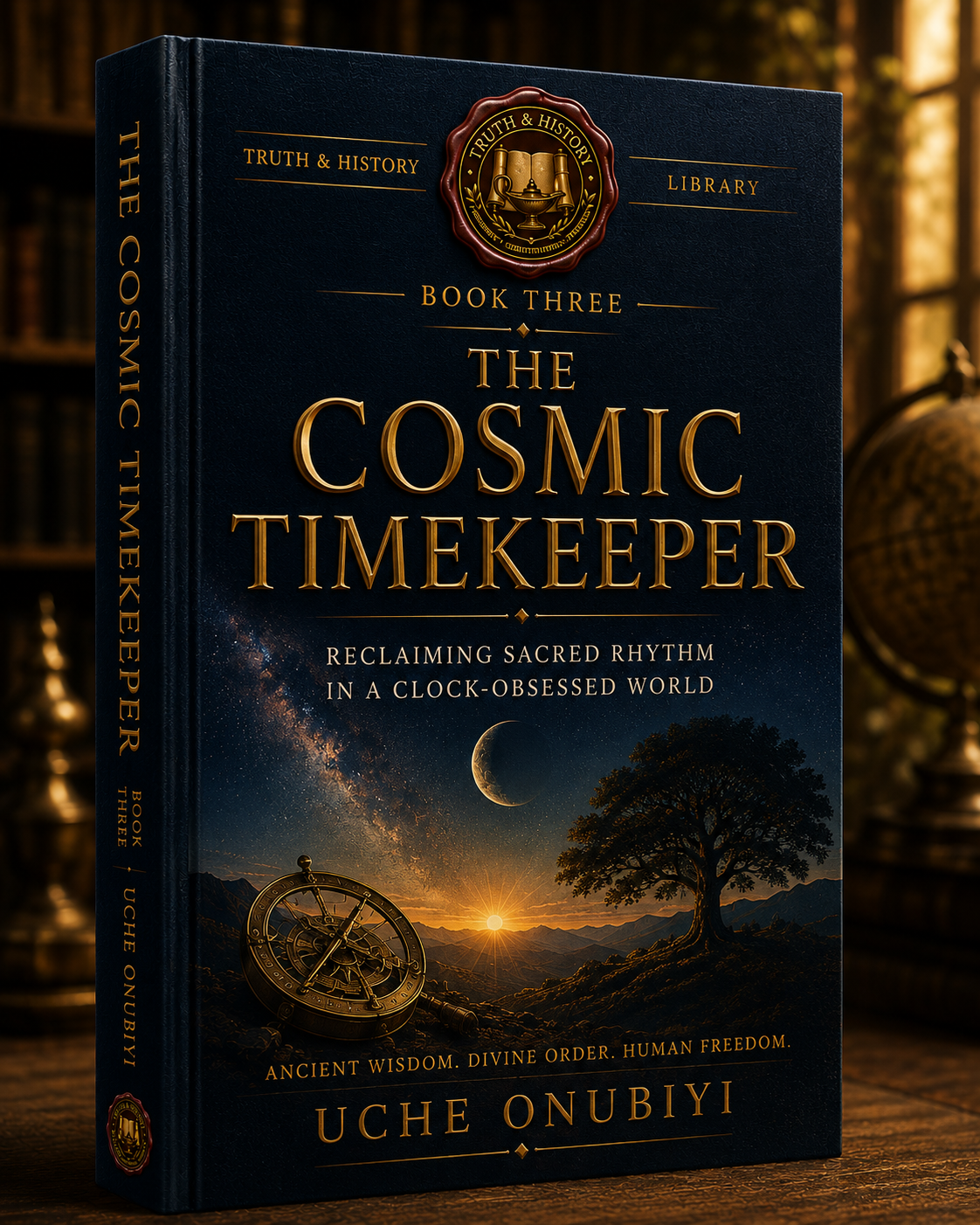
Read More
The Cosmic Timekeeper
Continue the wider exploration of linear time, living rhythms, cycles, seasons and humanity's relationship with the architecture of time.
Read the Book →